


Search for the best commercial energy storage system and you will find a wall of spec sheets, all claiming to be the leader. What you will not find is a definition of "best" that applies to your site, your load profile, and your electricity tariff.
That is the problem this article solves. Rather than ranking products against a generic scorecard, it lays out the criteria that actually determine whether a delivers a return - and the product archetypes that tend to fit specific use cases.

What Changed in 2026
The C&I storage market has matured noticeably over the past two years, and the shifts matter to buyers.
LFP is now the default chemistry. Nearly every serious commercial product uses lithium iron phosphate cells. High-nickel chemistries have retreated to niche high-energy applications. This is good news for buyers: safety and cycle life are no longer the differentiator they once were, which pushes competition to system integration, controls, and service.
1500V DC architecture is spreading down-market. What was a utility-scale feature is now common in multi-megawatt commercial systems, cutting copper, losses, and balance-of-system cost.
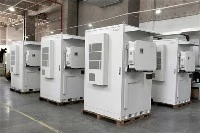
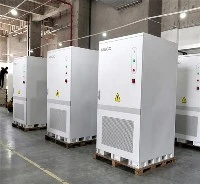
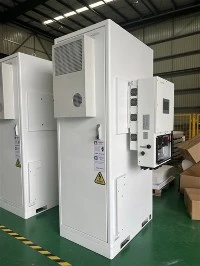
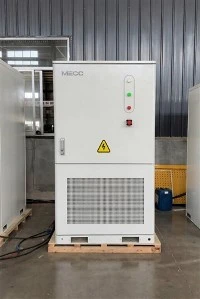
Density keeps climbing. A single outdoor cabinet now commonly houses 100 to 215 kWh with integrated PCS, thermal management, and fire suppression - capacity that used to require a small container.
Controls have become the product. platforms include load forecasting, tariff optimisation, demand-charge management, and increasingly AI-driven dispatch. Two systems with identical cells can perform very differently based on the software layer.
Safety expectations have hardened. NFPA 855UL 9540UL 9540A cell-level thermal runaway testing are now baseline procurement requirements in North America, with IEC 62619 and related standards governing global deployments.
Warranties have extended. Ten-year performance guarantees with defined capacity-retention curves are now normal, and some vendors offer longer terms with augmentation options.
1. Load-profile fit. Before comparing products, you need a load profile. A system sized for peak shaving looks nothing like one sized for TOU arbitrage or backup. Duration follows duty: most C&I sites need one to four hours; sites targeting resilience or solar shifting may need six or more.
2. Usable capacity, not nameplate. Datasheet capacity is measured under specific conditions - temperature, C-rate, depth of discharge, and end-of-life definition. Ask for usable capacity at your operating conditions and at year ten, not at beginning of life at 25℃.
3. Round-trip efficiency, honestly stated. Published figures range from 85% to 92%. Check whether the number includes auxiliary loads - thermal management, controls, transformer losses. A system quoting 90% AC-to-AC with HVAC excluded may deliver less in practice.
4. C-rate and duration match. A one-hour system and a four-hour system use different cell designs and different power electronics. Over-specifying power wastes capital; under-specifying it forces curtailment.
5. Thermal management. Liquid-cooled systems typically hold tighter cell temperature uniformity, which slows degradation and reduces derating in hot climates. Air-cooled systems are simpler and cheaper. The right answer depends on your climate and duty cycle - not on a generic preference.
6. PCS and inversion quality.grid-forming mode for islanding and microgrid duty. Specify the PCS capabilities your site actually needs.
7. BMS depth and transparency. Beyond basic protection, look for cell-level monitoring, state-of-health reporting, and - critically - data ownership. Can you export the data? Does the BMS integrate with your existing SCADA or building management system?
8. EMS and dispatch intelligence. Ask how the system optimises. Fixed schedules? Forecast-driven? Tariff-aware? Can it participate in demand response or ancillary markets? This is where ROI is won or lost.
9. Certifications and compliance path.UL 9540UL 9540ANFPA 855 standards for your market. Request the actual certificates, not a compliance statement in a brochure.
10. Warranty structure and bankability. Read the performance guarantee carefully. What capacity retention is promised, at what throughput, under what temperature conditions? Who backs the warranty, and is there a financial instrument behind it? Also clarify what happens on augmentation and end-of-life recycling.
11. Service network and spares. A storage system is a 15-year asset. Ask where the nearest service technician is, what the spare-parts lead time is, and what remote diagnostics are available. Response time commitments should be contractual.
12. Cybersecurity. A connected BESS is an attack surface. Look for secure architecture and standards alignment such as IEC 62443, plus clear data handling and firmware update policies.
13. LCOS, not capex. The cheapest system per kWh is often not the cheapest to own. Model including auxiliary energy, degradation, augmentation, and maintenance. A higher upfront price with better efficiency and a flatter fade curve frequently wins.
14. Footprint and site constraints. Weigh pad space, clearances, weight loading, and fire separation requirements. A denser system can turn an infeasible site into a feasible one.

Outdoor cabinets (roughly 100–215 kWh). Integrated, pre-tested, fast to deploy. Ideal for sites with limited space, distributed placement near loads, or phased expansion. Typically liquid-cooled with integrated PCS and suppression.
Containerised systems (roughly 1–5 MWh). The workhorse for larger C&I projects and multi-hour durations. Better cost per kWh at scale, but require pad space, clearances, and more substantial civil work.
All-in-one commercial units. Factory-assembled with PCS, EMS, and thermal management integrated. Lower engineering and commissioning effort - a strong option for buyers without in-house power engineering.
Microgrid-ready systems. Include grid-forming inverters and islanding capability. Higher cost, but the only option when resilience is a primary driver.
DC-coupled solar-plus-storage. Higher round-trip efficiency when the primary duty is storing solar generation and shifting it to evening peaks.
Red Flags in a 2026 Procurement
Vague or non-existent performance guarantee terms
Efficiency quoted AC-to-DC or without auxiliary loads
No UL 9540A report available on request
Cycle life stated without defining depth of discharge and end-of-life threshold
Build a single load-profile model. Send it to every shortlisted vendor and require each to return the same outputs: usable capacity at year one and year ten, simulated bill savings using your actual tariff, auxiliary energy consumption, and a full LCOS calculation. Hold the assumptions constant across all respondents.
Then evaluate on three axes: technical fit, commercial terms, and service capability. Products with identical cells will separate themselves almost entirely on the last two.
There is no single best commercial energy storage system in 2026. There is the system that best matches your load profile, your tariff, your climate, your space, and your risk tolerance - and that you can keep serviced for fifteen years.
Buyer's criteria should come before product comparison, not after. Define duration, power, efficiency, certification, and LCOS requirements first. Vendors that cannot meet a clearly stated specification will eliminate themselves, and your shortlist will be short for the right reasons.

500KW/1MW 1MWh/2MWh Battery Energy Storage System Container
The 500kW/1MW 1MWh/2MWh Battery Energy Storage System Container is a turn‑key utility‑grade energy storage solution housed in standard 20ft or 40ft shipping containers, integrating bidirectional PCS, A‑grade LiFePO4 battery clusters, master BMS, liquid‑cooled thermal management, gas fire suppression, high‑voltage distribution and EMS energy management system with full factory pre‑assembly and pre‑commissioning. Requiring only foundation construction and high‑voltage cable connection for on‑site commissioning, it supports flexible power‑capacity configuration and multi‑container parallel expansion, delivering core capabilities of peak‑shaving and load shifting, renewable energy smoothing, frequency‑voltage grid support, islanded micro‑grid operation and large‑scale emergency backup. Featuring IP54 enclosure protection and comprehensive multi‑layer safety mechanisms, it adapts to diverse harsh outdoor environments, and is widely deployed for ground‑mounted PV power stations, industrial parks, mining operations, island microgrids and grid‑side auxiliary service projects to stabilize grid fluctuations, boost renewable energy utilization and reduce comprehensive energy costs.